Filling a VP or C-suite role has almost nothing in common with filling a mid-level position, and treating the two processes the same is one of the more common ways companies end up with a leadership gap that drags on for months. Executive recruitment in the Philippines runs on a different timeline, a different sourcing method, and a different definition of what counts as a good match. Here’s how the process actually works.
Why Executive Hiring Is a Different Process
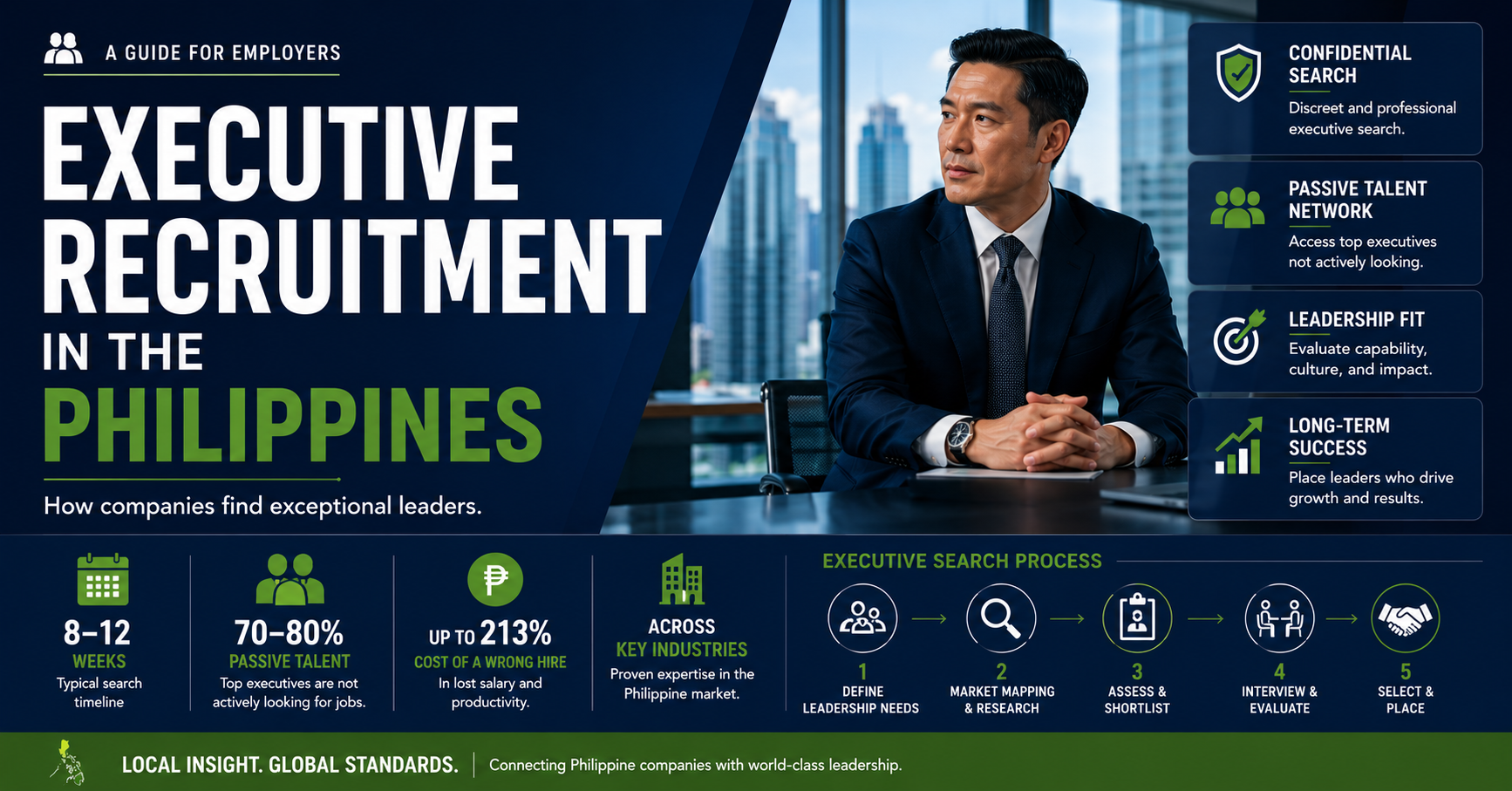
The candidates worth hiring for senior roles are almost never applying anywhere. They’re performing well where they are, not actively job hunting, and reachable only through direct, often confidential outreach rather than a posted opening. That changes everything about how the search has to run — it starts with identifying who in the market fits the profile, not with waiting to see who responds to a listing.
It also changes what “fit” means. A senior hire isn’t just evaluated on technical or functional competence; cultural alignment, leadership style, and the ability to operate with limited oversight matter just as much, and getting that wrong is expensive. One widely cited industry estimate puts the cost of a bad senior hire at up to 213% of that person’s annual salary once severance, replacement search costs, and lost productivity are accounted for.
The Identification Stage: Talent Mapping and Confidential Outreach
Executive search begins with mapping the market — identifying who currently holds equivalent or adjacent roles at comparable companies, understanding their trajectory, and building a shortlist before any candidate is contacted. Outreach at this level is deliberately discreet: reaching out to a sitting executive about a new opportunity requires framing that respects their current position and doesn’t put them at risk with their employer. This stage alone typically takes three to four weeks for a well-scoped search.
The Assessment Stage: Competency and Cultural Fit
Once candidates are engaged, assessment goes well beyond a standard interview. Executive searches commonly involve structured competency evaluations, in-depth interviews with multiple stakeholders, and sometimes psychometric or leadership-style assessments to gauge how a candidate operates under the specific pressures of the role. This matters because the data on executive failure is fairly consistent across sources: a large share of executive hires that don’t work out fail on cultural or leadership-style misalignment rather than a lack of technical competence.
Approach and Courtship: Moving a Passive Executive
Convincing a successful, currently-employed executive to consider a move is a different skill than filling a standard vacancy. It typically involves multiple conversations over weeks, not a single interview cycle — building trust, addressing concerns about the move, and only then discussing specifics like compensation. Rushing this stage is one of the more common reasons a strong candidate quietly drops out of a process rather than saying no outright.
Timeline: What to Realistically Expect
Executive search timelines vary more than most hiring managers expect, and the range reported across the industry is wide enough that it’s worth setting expectations early rather than assuming a fixed number of weeks.
| Search Stage | Typical Duration |
| Talent mapping & confidential outreach | 3–4 weeks |
| Candidate assessment & shortlisting | 2–4 weeks |
| Interviews, panel review, internal alignment | 2–4 weeks |
| Offer negotiation & close | 1–3 weeks |
| Standard search, start to offer | 8–12 weeks |
| Complex or highly senior search | 4–6 months |
Roles with board involvement, relocation requirements, or highly specific industry experience tend to land at the longer end of this range. A firm quoting a fixed, short timeline regardless of role complexity is worth questioning rather than taking at face value.
The Cost of Getting It Wrong
The financial case for running executive search properly — rather than rushing it or handling it entirely in-house without specialist support — comes down to two numbers worth keeping in view throughout the process.
| Cost Factor | Estimated Impact |
| Cost of a leadership vacancy (per ~42 days unfilled) | Roughly $4,000–$4,200 in lost productivity and opportunity cost |
| Cost of a wrong senior hire | Up to 213% of the role’s annual salary |
| Share of senior roles taking 90+ days to fill | Roughly 40% |
Read together, these numbers explain why executive search firms are built around thoroughness rather than speed. A vacancy is costly, but a wrong hire at this level costs several times more — which is why a rushed process rarely saves money in the end, even though it feels faster upfront.
A7’s Approach to Executive Search
A7 Recruitment Corporation is a Filipino-owned talent solutions provider with offices in Makati and Cebu. Originally operating within Kforce’s Philippine IT staffing network (formerly Vértere Global Solutions, Inc.), A7 has grown into a fully integrated recruitment firm offering Permanent Placement, Executive Search, and Recruitment Process Outsourcing. As an IBPAP member, A7 works with clients across IT, BFSI, FinTech, BPO, Real Estate, Energy, FMCG, Digital Marketing, Logistics, and Manufacturing.
A7’s executive search process follows the structure outlined above — confidential talent mapping, structured assessment against both competency and cultural fit, and a realistic timeline set at the start of the engagement rather than promised and missed later. For companies navigating a leadership transition, that structure is what separates a search that produces the right long-term hire from one that just fills the seat quickly.
To discuss an executive hiring requirement with A7 Recruitment, contact our team at https://a7recruitment.com/contact-us/ or explore our services at https://a7recruitment.com/services/.