A company that needs to hire fifty people in a quarter and a company that wants someone else to run its customer support are both talking about outsourcing, but they are buying very different things. The first needs RPO. The second needs BPO.
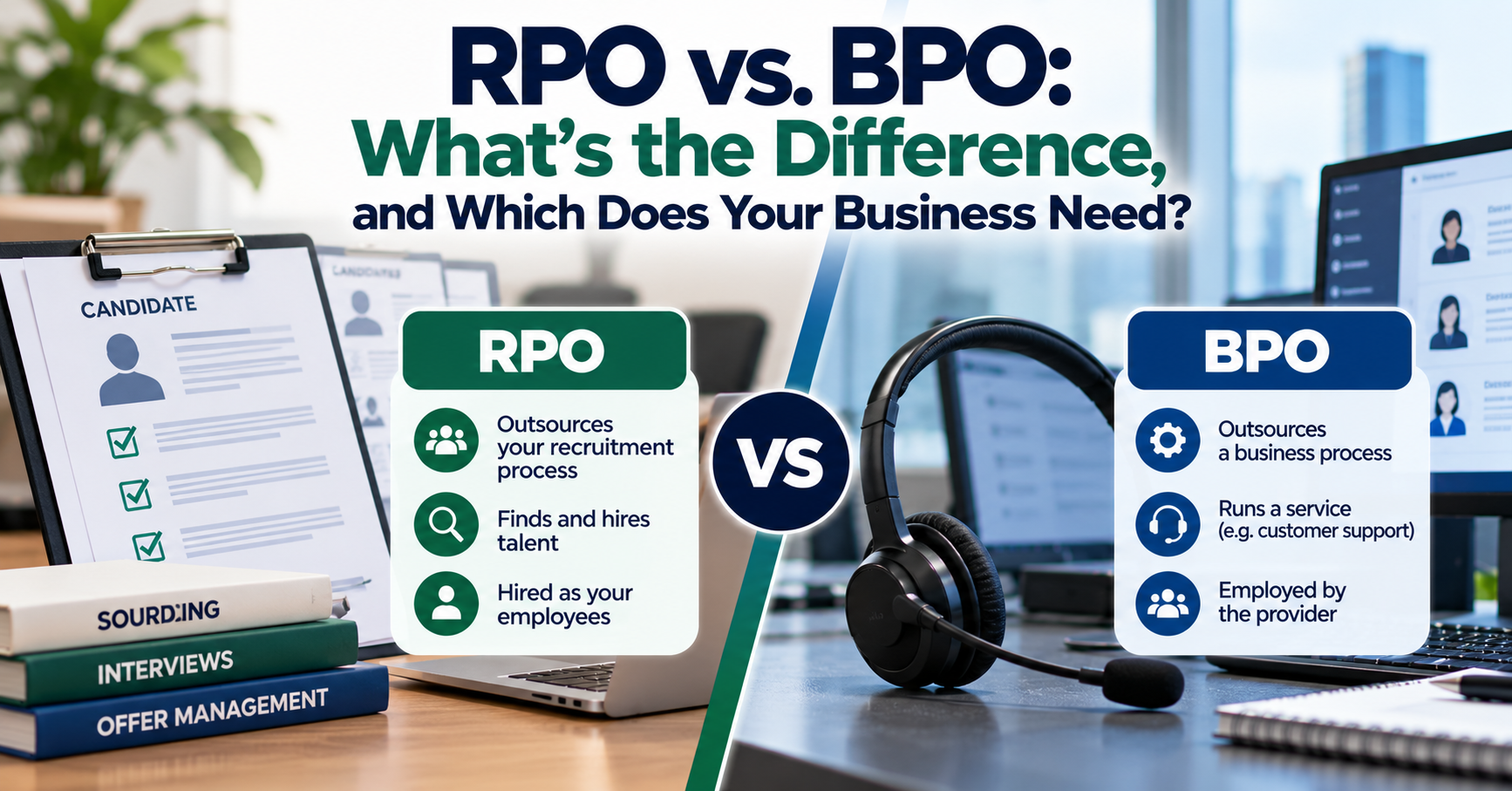
RPO, or Recruitment Process Outsourcing, means an outside provider runs some or all of your hiring, and the people hired still join your own payroll. BPO, or Business Process Outsourcing, means an outside company runs a business function for you, such as customer support or accounting, using its own employees. Put simply, RPO changes how you hire, while BPO changes who does the work.
The acronyms look alike and both involve handing work to a specialist, which is why they get confused, and why a mix-up often ends with a conversation with the wrong vendor. The rest of this article explains where the two differ and how to tell which one your business actually needs.
Recruitment Process Outsourcing in Brief
Recruitment Process Outsourcing is an arrangement in which an external provider manages some or all of a company’s recruitment work, from sourcing and screening to interview coordination and offer management. The people hired through RPO become the client’s own employees. The provider is outsourcing the effort of finding and assessing candidates, not the employment itself.
This article focuses on how RPO differs from BPO. For a full walkthrough of how an RPO engagement works, the main engagement models, and when it pays off, read our guide to Recruitment Process Outsourcing in the Philippines.
What does Business Process Outsourcing mean
Business Process Outsourcing is the practice of contracting an external company to run a specific business function. In the Philippines, the term is most associated with the large industry that provides customer support, technical support, finance and accounting, HR administration, and similar services to companies overseas. The workers belong to the BPO provider, and the client buys the outcome of the process, such as resolved customer tickets or processed invoices.
RPO vs. BPO at a glance
| Factor | RPO | BPO |
| What is outsourced | The recruitment function | A business process, such as customer support or accounting |
| Who the workers are | Hired as the client’s own employees | Employed by the provider and deployed to the client’s work |
| What the client buys | Hiring capacity, speed, and sourcing expertise | A running service or process outcome |
| Typical trigger | High hiring volume, thin internal HR capacity, specialist roles | Cost, scale, or lack of in-house expertise in a non-core function |
| Success measured by | Time to fill, quality of hire, hiring cost | Service levels, accuracy, turnaround time |
Why the confusion happens
Recruitment is itself a business process, so RPO is sometimes described as a specialized type of BPO. That is technically fair, and the two are related. In practice they are bought by different people for different reasons. A head of talent acquisition evaluating RPO is thinking about hiring pipeline and quality of hire. A head of operations evaluating BPO is thinking about service delivery and cost per transaction.
The vendors, contracts, and success measures rarely overlap. There is a second point of confusion specific to the Philippines. Because BPO is such a large employer here, a lot of recruitment activity is about hiring for BPO companies. A recruitment firm that supports BPO employers is not a BPO provider. It is a recruitment partner serving that industry.
Which one does your business need?
Start with the problem you are trying to solve.
If the problem is “we cannot hire fast enough or well enough,” you are looking at RPO or a recruitment partner. Typical signs include repeated unfilled roles, recruiters stretched across too many requisitions, hiring spikes tied to expansion, or a sense that the same sourcing channels keep returning the same candidates.
If the problem is “we need this work done, and we do not want to staff it ourselves,” you are looking at BPO. Typical signs include a non-core function that is expensive to build in-house, round-the-clock coverage you cannot staff internally, or work that scales unpredictably.
Some companies need both, and that is common. A growing business might outsource its customer support to a BPO provider while using RPO to build its internal product and finance teams. The two arrangements sit side by side without conflict.
Where to go next
If the problem you described above is a hiring problem, start with our guide to RPO in the Philippines, which covers engagement models, when RPO makes sense, and what to look for in a provider. Our Recruitment Process Outsourcing service page describes how A7 approaches it.
A7 Recruitment’s approach
A7 Recruitment Corporation is a Filipino-owned talent solutions provider with offices in Makati and Cebu, offering Permanent Placement, Executive Search, and Recruitment Process Outsourcing. A7 supports employers across industries, including BPO, with recruitment services designed around how each client actually hires.
To discuss your hiring requirements with A7 Recruitment, contact our team at https://a7recruitment.com/contact-us/ or explore our services at https://a7recruitment.com/services/.