The Philippines has established itself as one of Asia’s most compelling hiring destinations. A large, English-proficient workforce, competitive salary expectations, a strong service culture, and a talent pool that spans IT, finance, BPO, energy, FMCG, and beyond — the case for hiring here is clear.
But the process is not plug-and-play. Philippine labor law has specific requirements around employment contracts, mandatory benefits, and regularization that differ significantly from Western markets. Getting them wrong exposes your business to legal and operational risk.
This guide covers everything a company new to Philippine hiring needs to know — from legal foundations to practical steps to choosing the right recruitment partner.
Understanding the Philippine labor framework
All employment in the Philippines is governed primarily by the Labor Code of the Philippines and enforced by the Department of Labor and Employment (DOLE). For employers, the most critical concepts to understand upfront are:
Probationary employment and regularization
Employees in the Philippines typically serve a probationary period of up to six months. During this time, employers assess fit against reasonable standards that must be communicated at the start of employment. At the end of six months, an employee who continues working is deemed regular and gains full tenure protections — meaning termination requires just cause or authorized cause with proper notice and process.
This is one of the most common compliance gaps for foreign companies entering the Philippine market. Regularization is automatic under the law, not a separate step you opt into.
Employment contract requirements
While verbal employment is technically valid, DOLE strongly advises written contracts for all employees. A proper employment contract should specify:
• Position, duties, and reporting structure
• Compensation and pay schedule
• Probationary period duration and performance standards
• Benefits (statutory and company-provided)
• Grounds for termination consistent with the Labor Code
Mandatory statutory benefits
All regular employees in the Philippines are entitled to statutory benefits that employers are legally required to remit. These include:
| Benefit | Governing Body | Employer Contribution |
| SSS (Social Security) | SSS | ~9.5% of monthly salary |
| PhilHealth (health insurance) | PhilHealth | ~5% of monthly salary (shared) |
| Pag-IBIG (housing fund) | HDMF | ₱100–₱200/month minimum |
| 13th month pay | DOLE | 1/12 of annual basic salary |
Non-remittance of SSS, PhilHealth, and Pag-IBIG contributions is a criminal offense under Philippine law. Employers — including officers of foreign companies with Philippine operations — can face personal liability.
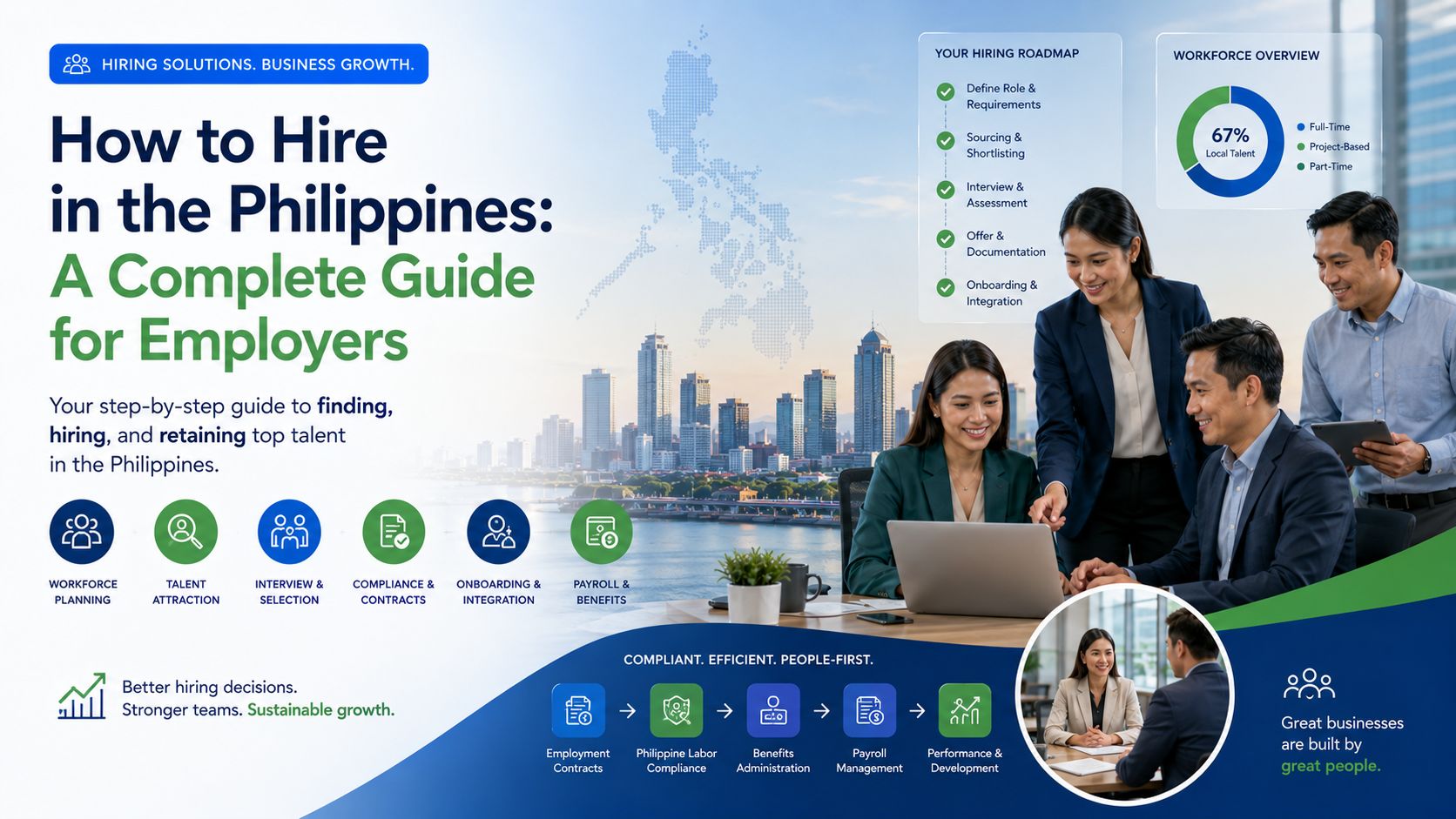
The hiring process step by step
Step 1: Define the role clearly
Before posting a vacancy, document the role’s responsibilities, required qualifications, reporting lines, and performance expectations. This serves as the basis for the employment contract’s probationary standards — which must be communicated to the employee on Day 1.
Step 2: Choose your hiring method
You have several options for sourcing candidates in the Philippines:
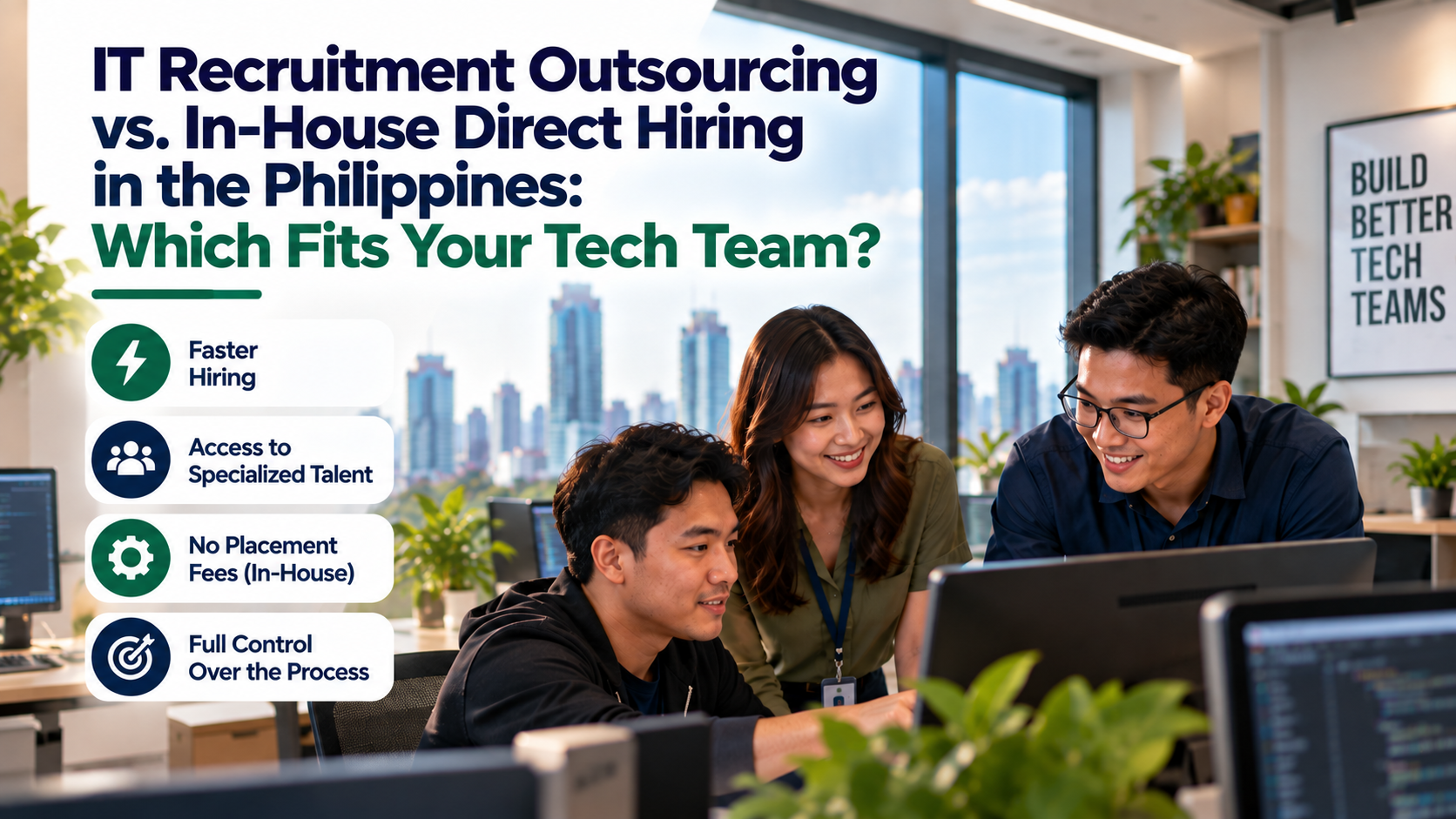
• Direct hiring — managing the process internally using job boards such as JobStreet, LinkedIn, and Kalibrr
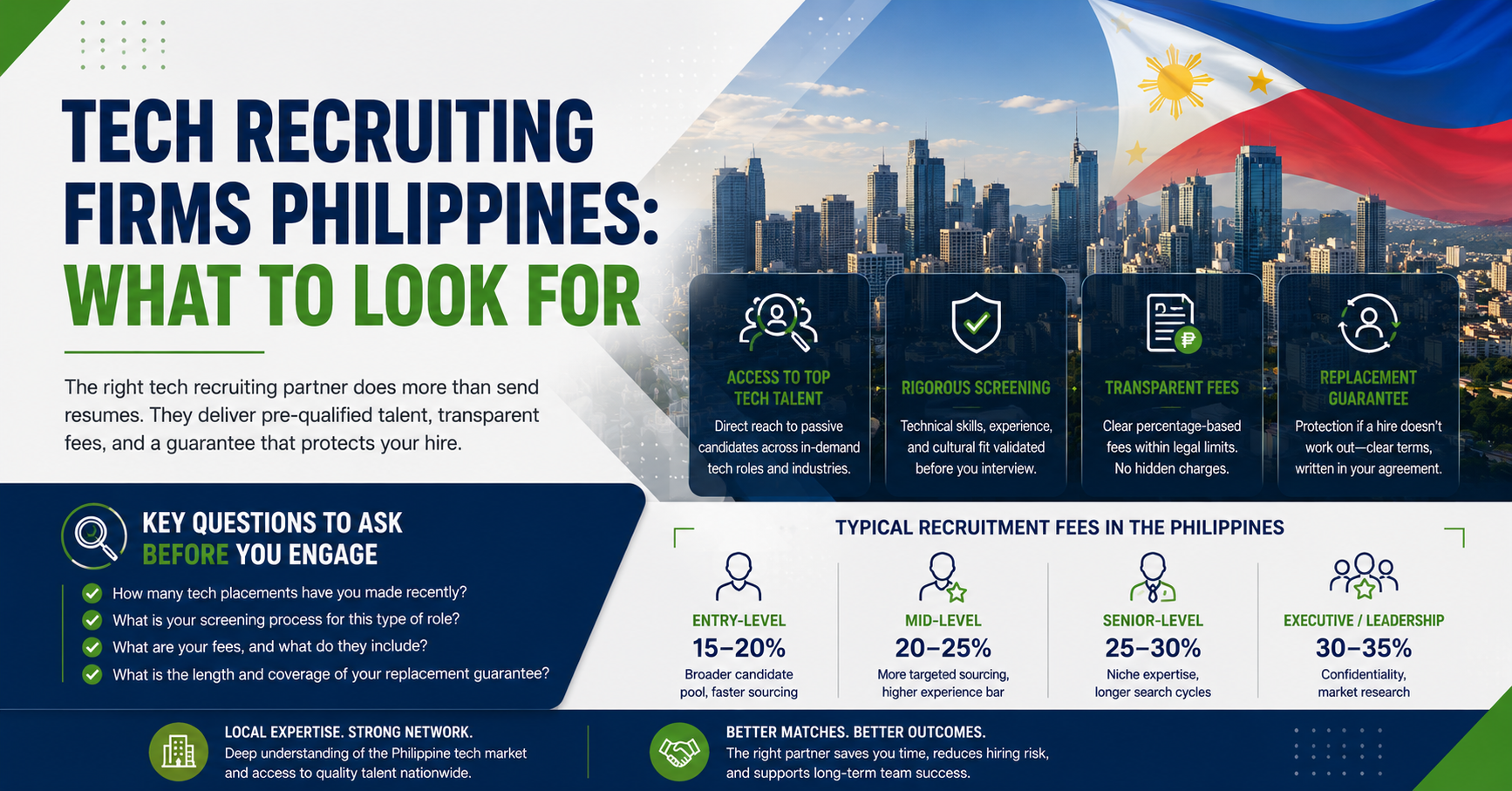
• Recruitment agency — a third-party firm that sources, screens, and shortlists candidates on your behalf
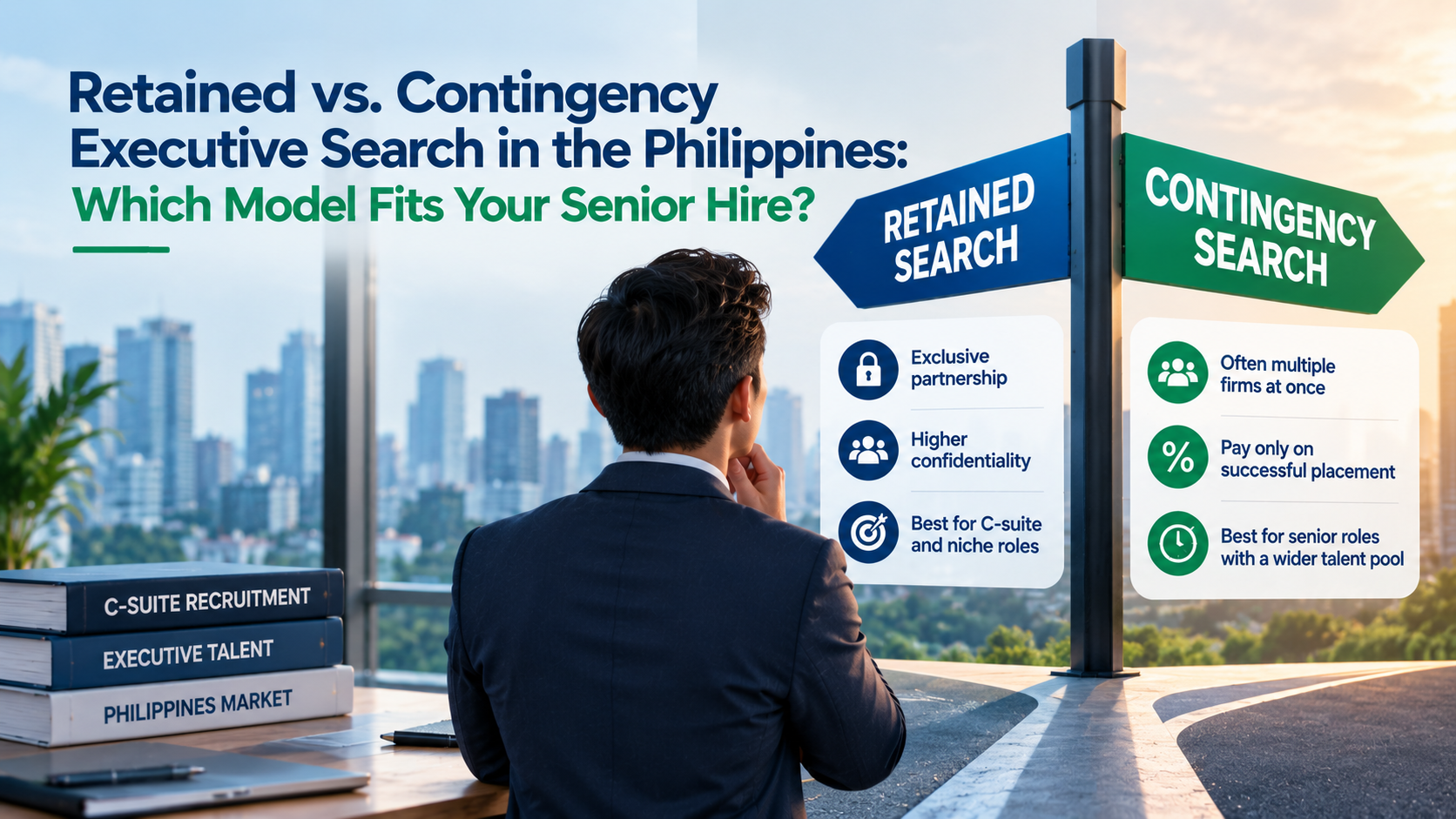
• Executive search — for senior and specialist roles where passive candidates need to be directly approached
• RPO (Recruitment Process Outsourcing) — fully outsourcing your recruitment function to a provider who embeds into your operations
For companies that are new to the Philippine market or hiring at volume, working with a local recruitment partner significantly reduces time-to-hire and compliance risk.
Step 3: Screen and assess candidates
Screening in the Philippines typically follows this sequence: resume review, phone screen, competency-based interview, technical or psychometric assessment (depending on the role), and background verification. Reference checks are standard practice and candidates generally expect them for professional roles.
Step 4: Issue a formal job offer
A job offer letter should confirm the role, compensation, start date, and any conditions (e.g. background check clearance). Verbal offers are common but a written offer protects both parties. Note that once an offer is accepted, withdrawing it without cause can expose the employer to legal action.
Step 5: Onboard properly
Enroll the employee in SSS, PhilHealth, and Pag-IBIG immediately. Provide a written employment contract on or before Day 1, clearly stating probationary standards. Introduce the employee to HR policies, workplace rules, and reporting expectations. Consistent, documented onboarding is your best protection against early-tenure disputes.
Common hiring mistakes foreign companies make
| Mistake | Risk | How to avoid it |
| Not communicating probationary standards | Employee deemed regular after 6 months regardless | Document standards in the contract, signed on Day 1 |
| Misclassifying employees as contractors | DOLE reclassification, back benefits, penalties | Only use contractor arrangements for genuinely project-based work |
| Delaying SSS/PhilHealth enrollment | Criminal liability for employer officers | Enroll within 30 days of employment start |
| Non-standard termination process | Illegal dismissal claim, reinstatement or back pay order | Follow the two-notice rule and due process requirements |
Salary benchmarking in the Philippines
Compensation expectations vary significantly by role, industry, and location. Metro Manila (Makati, BGC, Ortigas) commands premium salaries compared to provincial markets, while Cebu City sits in the middle tier and is increasingly competitive for IT and BPO roles.
As a general benchmark for professional roles:
| Role Level | Metro Manila Range (Monthly) | Cebu Range (Monthly) |
| Entry-level professional | ₱25,000 – ₱40,000 | ₱18,000 – ₱30,000 |
| Mid-level (3–5 years experience) | ₱45,000 – ₱80,000 | ₱35,000 – ₱60,000 |
| Senior/specialist | ₱90,000 – ₱150,000 | ₱65,000 – ₱110,000 |
| C-suite/VP level | ₱180,000 – ₱400,000+ | ₱130,000 – ₱280,000+ |
For detailed salary benchmarks by industry — including IT, BFSI, FinTech, BPO, and Real Estate — refer to A7 Recruitment’s Philippines Salary Guide 2025.
Why work with a Philippine recruitment agency
Philippine labor law is nuanced, and the talent market moves quickly. A local recruitment partner brings three things a foreign employer cannot easily replicate on their own: market knowledge, an established candidate network, and compliance fluency.
A7 Recruitment Corporation is a Filipino-owned recruitment firm with roots in enterprise-grade IT staffing. Originally operating as part of Kforce’s Philippine network, A7 has evolved into a fully integrated talent solutions provider offering Permanent Placement, Executive Search, and Recruitment Process Outsourcing across Makati, Cebu, and beyond.
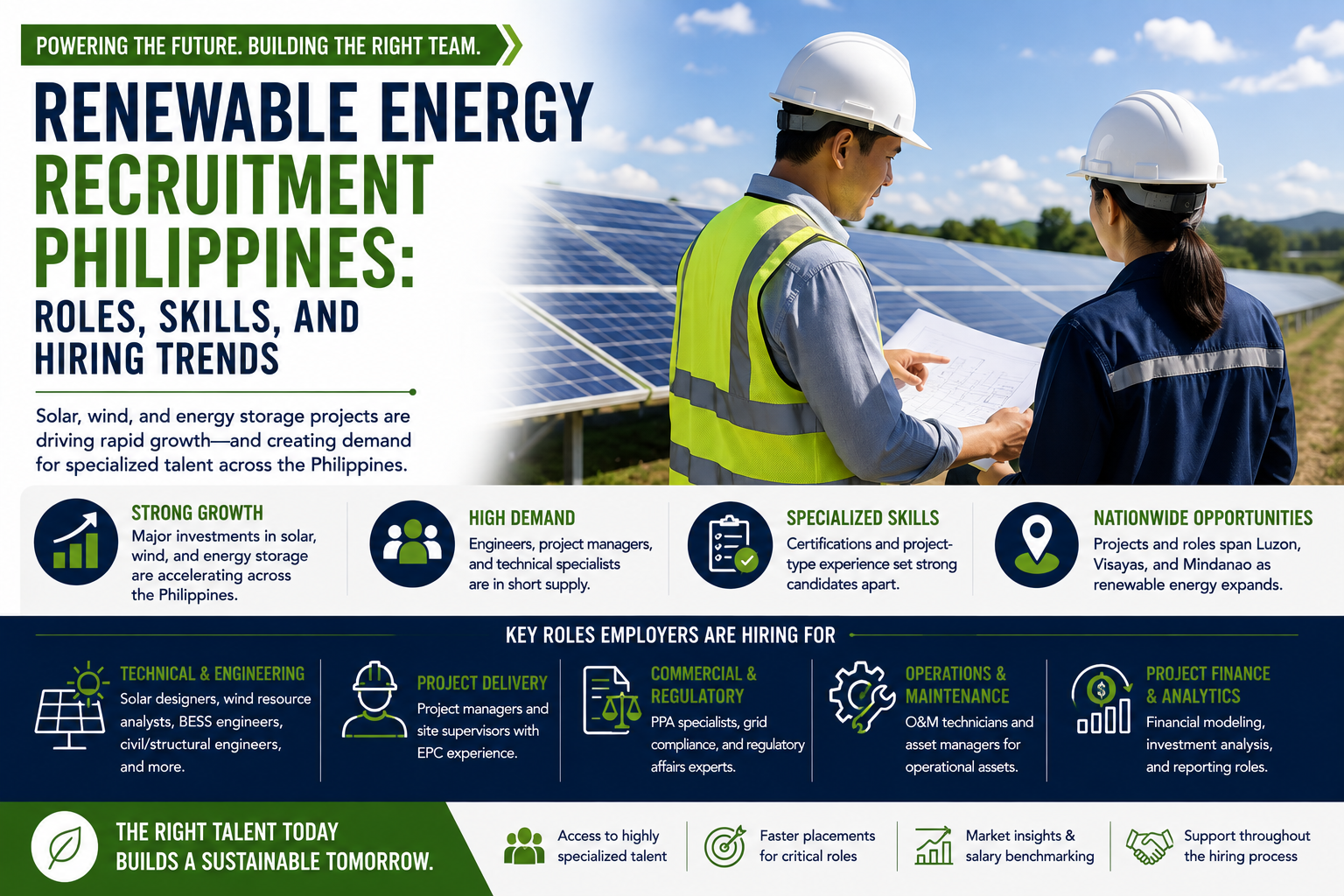
A7’s approach is built on understanding each client’s organizational DNA — not just filling roles, but architecting talent pipelines that serve long-term business goals. Across IT, BFSI, FinTech, BPO, Energy, FMCG, Real Estate, and Digital Marketing, A7 has the industry depth to source candidates others miss.
Ready to start hiring in the Philippines?
Whether you’re making your first hire or scaling a team of 50, getting the process right from the start saves time, money, and legal exposure down the line.
Talk to A7 Recruitment’s team about your hiring needs: https://a7recruitment.com/contact-us/
Explore A7’s services: https://a7recruitment.com/services/