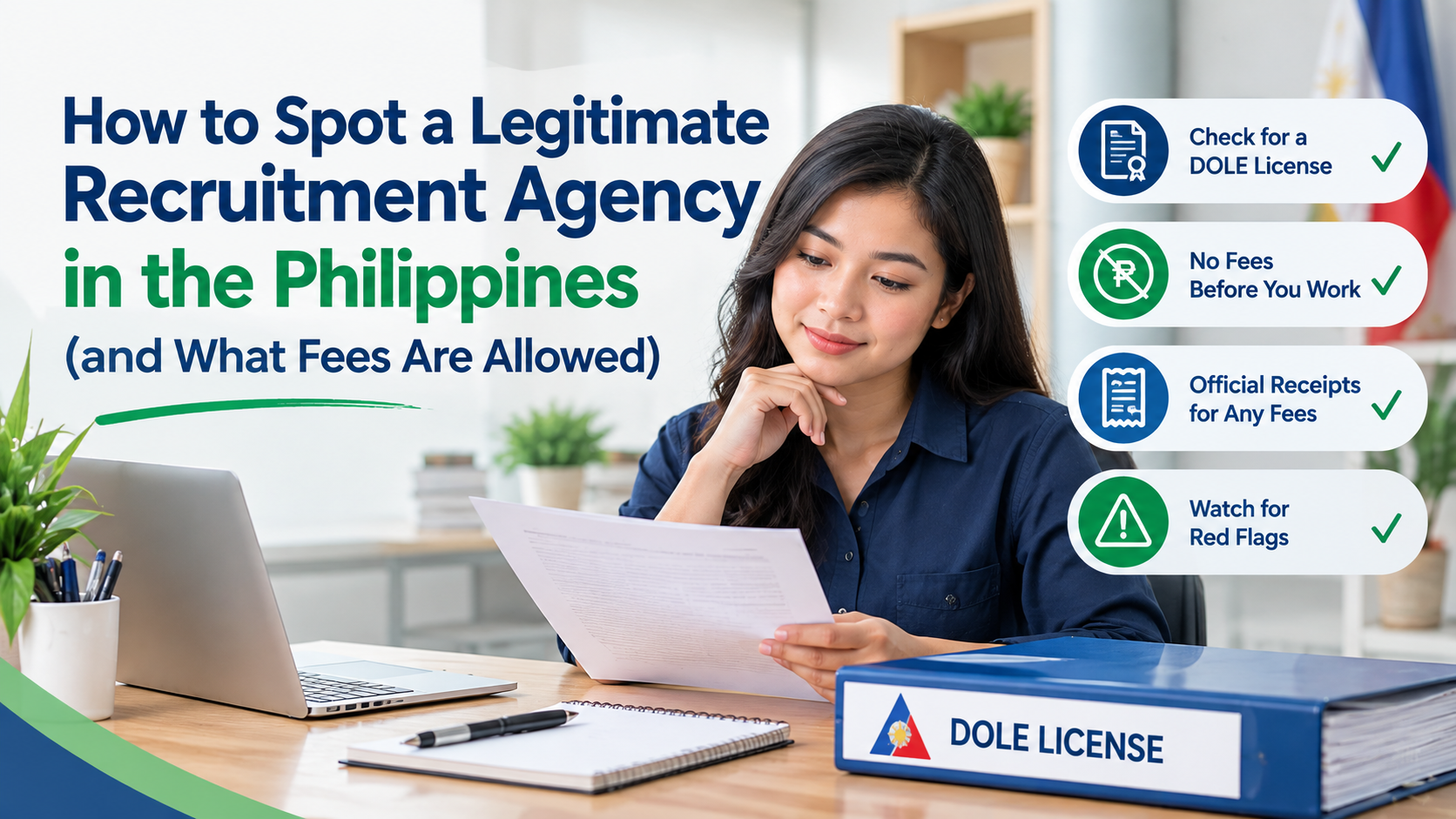
Jobseekers searching for terms like “how much does an agency deduct from my salary” are usually already dealing with a recruiter who has asked them for money, and that’s often the first sign something is wrong.
The Department of Labor and Employment (DOLE) regulates recruitment and placement agencies operating in the Philippines specifically to protect jobseekers from this kind of arrangement, and understanding what DOLE actually allows makes it much easier to tell a legitimate agency from one you should walk away from.
What DOLE requires of recruitment agencies
Under the Labor Code of the Philippines, any private entity engaged in recruitment and placement of workers, whether for local or overseas employment, must be licensed by DOLE to operate legally. For local employment specifically, this licensing falls under DOLE’s Bureau of Local Employment, and agencies are required to register and maintain that license to continue operating.
An agency that cannot produce a valid DOLE license, or that operates only through informal channels like social media messages with no verifiable office or registration, is not operating within the law regardless of how legitimate it appears.
What DOLE says about fees for local employment
This is where most confusion, and most predatory behavior, comes from. Under Article 32 of the Labor Code, a private fee-charging employment agency is not permitted to collect any fee from a worker until that worker has actually obtained employment and started working, and any amount collected must be covered by an official receipt showing the date, amount, and purpose of the payment.
In practice, this means a legitimate agency does not ask you to pay anything before you’ve been placed in a job and have actually begun working. For most professional and office-based hiring in the Philippines, the standard practice is that the agency’s fee is paid entirely by the employer who is filling the role, not by the jobseeker at all.
If you are ever asked to pay a fee, a “processing charge,” a “training fee,” or any amount before you’ve started a job, or if the request has no accompanying official receipt, that is a clear signal to stop and verify the agency’s legitimacy before proceeding.
Common red flags to watch for
| Red Flag | Why It Matters |
| Payment requested before an interview or job offer | Legitimate agencies do not require payment to be considered for a role or to be interviewed |
| No official, BIR-registered receipt for any amount collected | DOLE requires a receipt for any fee an agency is legally permitted to collect |
| No visible DOLE license or the agency refuses to show one | Licensing is a legal requirement, not optional, for any agency operating in the Philippines |
| Communication only through chat or social media, with no verifiable office | Legitimate agencies operate from a registered, physical business address |
| Pressure to pay quickly to “secure” a slot or guarantee placement | A genuine job offer does not depend on a payment deadline |
| Fees disguised under labels like “reservation fee” or “documentation fee” | The label doesn’t change what the payment actually is under the law |
| Request to send money to a personal account instead of the agency’s registered business account | A legitimate transaction is traceable to the agency, not an individual’s personal account |
How to verify an agency before you engage with it
Ask the agency directly for its DOLE license number and cross-check it, since DOLE maintains records of licensed agencies through its regional and Bureau of Local Employment offices. A legitimate agency will have no hesitation providing this.
It’s also worth confirming that the agency has a real, staffed office you can independently verify, and that any job order or vacancy they’re recruiting for can be reasonably explained, including the employer’s name and the actual role.
If you’re ever unsure, DOLE’s regional offices and hotlines can confirm whether a specific agency is currently licensed, and this single check resolves most uncertainty faster than trying to evaluate red flags on your own.
If you’ve already been asked for a fee
Don’t pay, and don’t feel pressured by a deadline. Document the request, including any messages, names used, and account details provided, and report it to DOLE. Reporting protects other jobseekers from the same approach, and it’s the appropriate next step whether or not you decide to pursue the role further.
Looking for a legitimate way in
A7 Recruitment is a DOLE-compliant recruitment agency working with employers across IT, BFSI, FinTech, BPO, and several other sectors in the Philippines. Browse open roles and register with A7 Recruitment at https://a7recruitment.com/careers/.
You can also contact our team at https://a7recruitment.com/contact-us/ or explore our services at https://a7recruitment.com/services/.