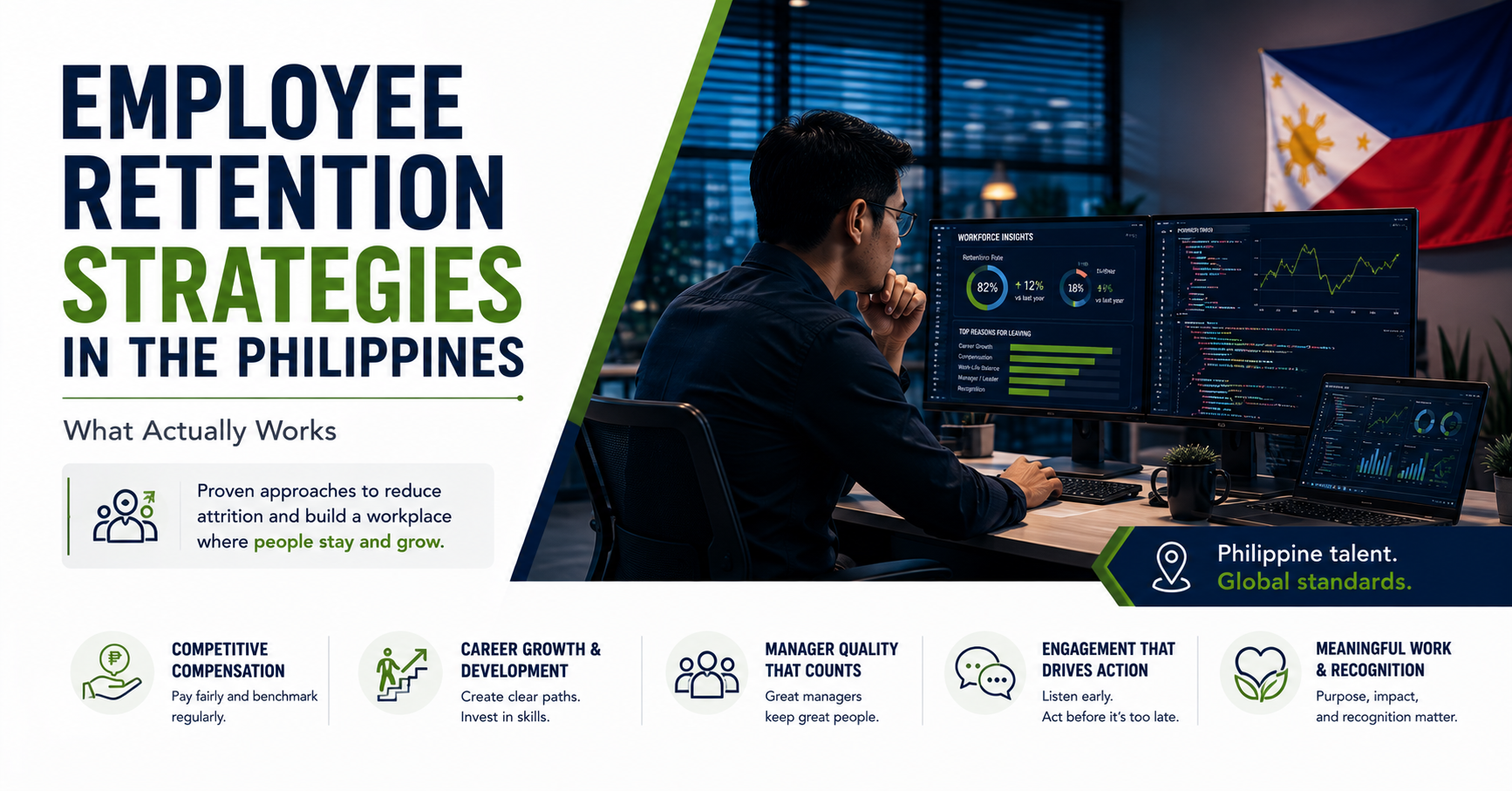
Attrition in the Philippines runs higher than in many comparable markets, particularly in IT, BFSI, and BPO, where candidates routinely field multiple offers at once and switching employers remains one of the fastest ways to increase pay. Employers who treat retention as an HR policy exercise — an engagement survey once a year, an exit interview after the fact — consistently lose people they could have kept. The employers who retain well treat it as an ongoing, role-by-role effort that starts well before someone hands in their resignation.
Why attrition runs high in this market
Several forces compound here that don’t apply equally elsewhere. Salary growth from switching employers is often faster than salary growth from staying, especially for mid-level technical and BPO talent. The recruitment market itself is active and visible — candidates are contacted directly and frequently, so the option to leave is always in front of them, not something they have to go looking for. And in sectors with skills shortages, such as IT, competitors are often willing to pay a meaningful premium simply to poach an already-trained employee rather than train a new one.
Understanding this context matters because it changes what retention actually needs to address. It is rarely just about pay — but pay dissatisfaction is usually the trigger that surfaces everything else an employee has been tolerating.
Do counter-offers work?
Counter-offers are the most common retention reflex, and they are also the least reliable. A counter-offer solves the immediate compensation gap but rarely addresses whatever prompted the employee to start looking in the first place — limited growth, a difficult manager relationship, or simply feeling undervalued until they had another offer in hand. Industry data and recruiter experience consistently point the same direction: a meaningful share of employees who accept a counter-offer leave within the following year regardless, because the underlying reason for looking never went away.
Counter-offers aren’t wrong to use, but they work best as a short-term bridge, not a substitute for addressing the actual cause. An employer that only ever responds to resignations, rather than to the signals that precede them, will keep having this conversation.
Compensation matters, but it has limits
Paying below market is the fastest way to guarantee attrition, and regular benchmarking against current Philippine market rates — not last year’s rates — is a baseline requirement, not a retention strategy on its own. Beyond a competitive baseline, however, additional pay increases show diminishing returns. Employees who are paid fairly but feel stuck, unsupported, or poorly managed will still leave for a lateral pay offer elsewhere if nothing else changes.
This is why the strongest-retaining employers pair compensation reviews with the other levers below, rather than treating pay as the whole answer.
Career development and internal mobility
A consistent pattern across Philippine employers with lower attrition: employees can see a next step inside the company, and that next step is real, not theoretical. This means documented promotion criteria, actual internal mobility between teams or departments, and managers who have career conversations proactively rather than only during annual reviews.
The absence of a visible path is one of the most common reasons capable mid-level employees leave, even when they are reasonably well paid. If the only way to grow is to leave, most will eventually take it.
Manager quality is a retention lever, not a soft metric
Employees leave managers more often than they leave companies. Poor manager quality — unclear expectations, no recognition, inconsistent feedback — erodes retention quietly and shows up in exit interviews as vague dissatisfaction that’s hard to trace back to a single cause. Employers serious about retention invest in manager training and hold managers accountable for their team’s attrition, not just their team’s output.
Engagement that goes beyond a survey
Annual engagement surveys measure sentiment after the fact. What actually moves retention is regular, structured check-ins where issues can surface and be addressed before an employee starts interviewing elsewhere. This doesn’t need to be elaborate — a consistent one-on-one cadence with genuine two-way conversation does more than a well-designed survey most employees fill out on autopilot.
Sector-specific notes
| Sector | Biggest Retention Driver | Why |
| IT and technical | Feeling that technical skills are current | Employers who invest in training, certifications, and exposure to modern tooling retain longer than those who don’t, even at comparable pay |
| BFSI | Visible career pathing | BFSI roles often have well-understood progression ladders that candidates compare directly against competitors |
| BPO | Shift and schedule stability, manager quality | Once compensation is at or near market rate, these are cited as bigger retention factors than base pay |
A7 Recruitment’s approach to retention-minded hiring
Retention starts at the hiring stage. A7 Recruitment works with employers to identify candidates whose expectations and career trajectory genuinely align with the role on offer, rather than optimizing purely for a fast fill. We also share current market compensation data so employers can benchmark accurately and address pay gaps before they become attrition risks.
To discuss your hiring requirements with A7 Recruitment, contact our team at https://a7recruitment.com/contact-us/ or explore our services at https://a7recruitment.com/services/.