
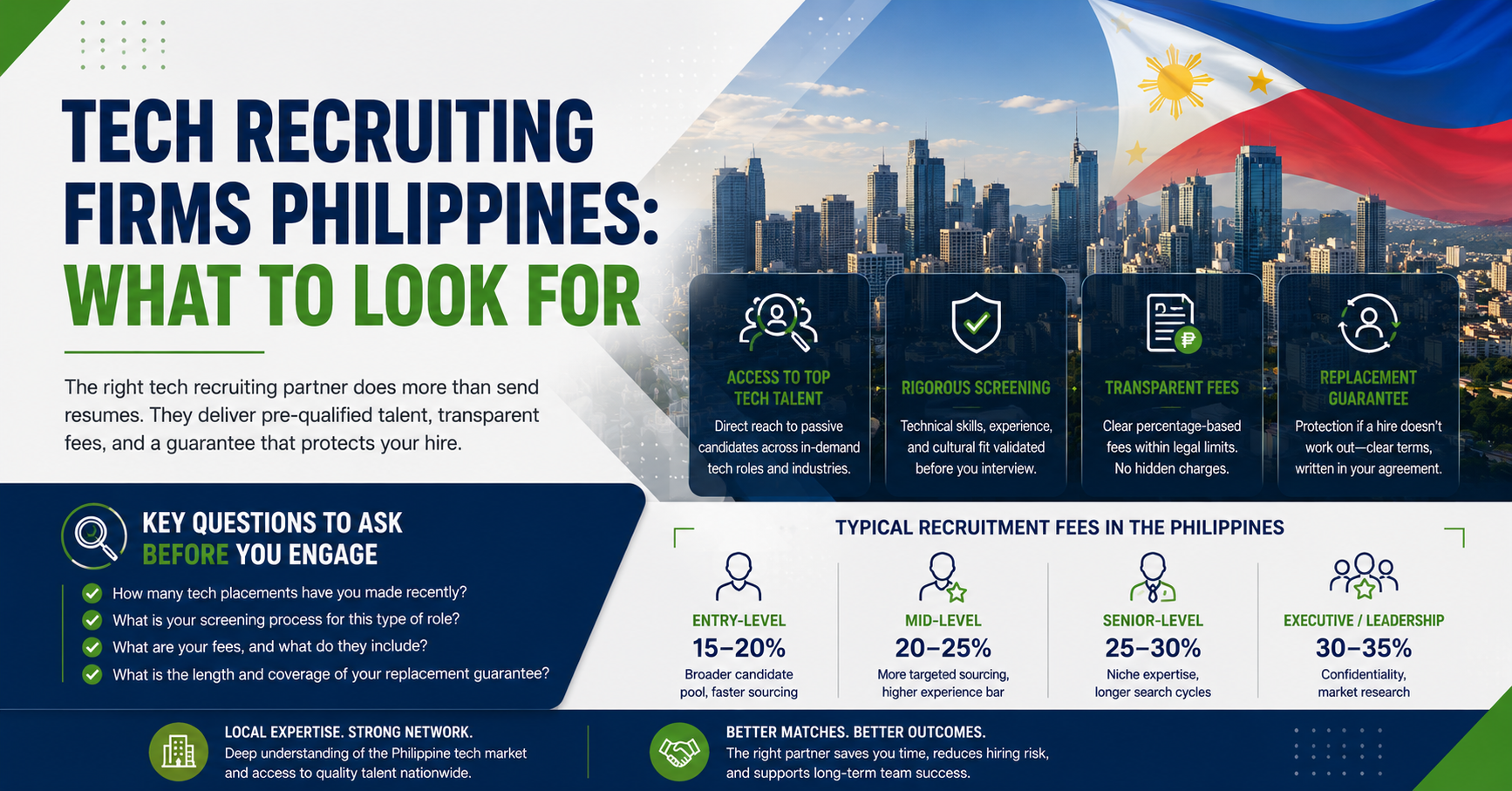
The Philippine tech recruiting market has no shortage of firms willing to take a job brief, and the number of tech recruiting firms in the Philippines competing for your business has only grown as demand for developers and technical specialists has climbed. What separates the ones worth hiring from the ones that will cost you a wasted search cycle isn’t visible in a sales pitch — it shows up in sector depth, screening rigor, fee transparency, and what actually happens if a placement doesn’t work out. This is what to check before signing an engagement.
Sector Depth Isn’t Optional
A generalist agency can fill an administrative role competently and still fail badly on a DevOps engineer search, because the two require entirely different sourcing networks and screening judgment. A firm with genuine tech sector depth should be able to speak specifically about the roles they’ve placed recently — not just “IT,” but the actual stack, seniority level, and industry context. If a recruiter can’t explain the difference between what a mid-level backend developer and a senior cloud architect search actually requires, that’s a sourcing gap that will show up in your shortlist.
Ask directly how many tech placements the firm has made in the past year, in what specializations, and for what size of client. Vague answers here are a reliable warning sign — a firm with real sector depth answers this without hesitation.
Process Rigor: How Candidates Are Actually Vetted
The core value of a recruiting firm is screening, not sourcing — anyone can forward resumes. What matters is whether candidates are evaluated against your specific technical requirements before you ever see a profile, or whether you’re doing that filtering yourself after the fact. Ask a prospective firm to walk through their screening process step by step: how they assess hands-on technical skill versus listed keywords, how they evaluate seniority and team fit, and who on their team is actually qualified to judge technical competence in the stack you’re hiring for.
A firm that can’t describe a structured process — and instead talks in generalities about “finding great people” — is likely running a sourcing operation, not a recruiting one.
What Fees Should Actually Look Like
Fee structures in the Philippine market follow fairly consistent patterns, and knowing the typical range helps you evaluate whether a quote is reasonable or inflated.
| Role Level | Typical Fee (% of first-year salary) | Reason |
| Entry-level | 15–20% | Broader candidate pool, faster sourcing |
| Mid-level | 20–25% | More targeted sourcing, higher experience bar |
| Senior-level | 25–30% | Niche expertise, longer search cycles |
| Executive / leadership | 30–35% | Confidentiality, headhunting, market research |
IT and technology roles specifically tend to sit at the higher end of these bands — commonly in the 20–30% range — because demand for developers and specialized technical talent regularly outpaces the pool of active candidates. A quote well outside these ranges isn’t automatically wrong, but it’s worth asking what specifically justifies the difference. Philippine labor regulations also cap what agencies can legally charge, so a reputable firm should be able to itemize its fee and confirm what’s included without hesitation.
Beyond the headline percentage, ask what the fee actually covers — sourcing and screening only, or also interview coordination, offer negotiation, and onboarding support. Some firms bill separately for job board advertising or background checks; a transparent firm will state this upfront rather than surfacing it after the search starts.
The Replacement Guarantee: What It Should Cover
Almost every firm will mention a replacement guarantee, but the terms behind that phrase vary enough that it’s worth checking in detail before you sign anything.
| What to Check | Why It Matters |
| Coverage period length | Shorter windows (30–60 days) protect against poor onboarding fit; longer windows (90+ days) protect against deeper mismatches |
| What triggers the guarantee | Resignation, termination for performance, or both — some firms exclude voluntary resignations |
| Whether the replacement search is truly free | Some firms charge a reduced fee rather than waiving it entirely |
| Whether the same recruiter handles the replacement search | Continuity matters — a different recruiter starting cold loses context on why the first hire didn’t work |
| Documentation in the service agreement | Verbal assurances aren’t enforceable — the terms should be written into the contract before the search begins |
A guarantee that isn’t specific on these points isn’t much of a guarantee. Firms confident in their screening process are typically the ones willing to put firm terms in writing.
Red Flags Worth Taking Seriously
A few patterns tend to predict a poor engagement regardless of how strong the initial pitch sounds. A firm that presents a large volume of candidates immediately, without a scoping conversation about your team and technical requirements, is usually sourcing broadly rather than screening specifically. A firm that can’t name recent, relevant placements when asked is either new to the tech vertical or exaggerating its specialization. And a firm reluctant to put fee structure or guarantee terms in writing before the search starts is one where “we’ll sort that out later” tends to mean the terms favor them, not you.
None of these are dealbreakers in isolation, but more than one showing up in an initial conversation is a reasonable basis to keep looking.
A7’s Approach
A7 Recruitment Corporation is a Filipino-owned talent solutions provider with offices in Makati and Cebu. Originally operating within Kforce’s Philippine IT staffing network (formerly Vértere Global Solutions, Inc.), A7 has grown into a fully integrated recruitment firm offering Permanent Placement, Executive Search, and Recruitment Process Outsourcing. As an IBPAP member, A7 works with clients across IT, BFSI, FinTech, BPO, Real Estate, Energy, FMCG, Digital Marketing, Logistics, and Manufacturing, with tech recruiting as one of its most active specializations given current market demand.
A7’s screening process is built around the checks outlined above — candidates are qualified against the specific technical requirements of the role before ever being presented, fee structures are scoped and confirmed upfront, and replacement guarantee terms are documented in the service agreement before a search begins. Employers evaluating recruiting partners are encouraged to ask A7 the same questions they’d ask any firm; the answers are part of how the process is designed to work.
To discuss your tech hiring requirements with A7 Recruitment, contact our team at https://a7recruitment.com/contact-us/ or explore our services at https://a7recruitment.com/services/.