For companies that hire regularly — whether building a BPO team, scaling an IT function, or managing rolling headcount across multiple sites — the question of how to run recruitment efficiently eventually becomes strategic. At some point, the cost and bandwidth consumed by managing hiring internally begins to outweigh the perceived benefit of keeping it in-house.
Recruitment Process Outsourcing (RPO) is the solution most companies reach when they get there. But it is frequently misunderstood — confused with a staffing agency, a headhunter, or simply ‘outsourcing HR.’ This article explains what RPO actually is, how it works in the Philippine context, and how to determine whether it fits your business model.
What RPO is — and what it is not
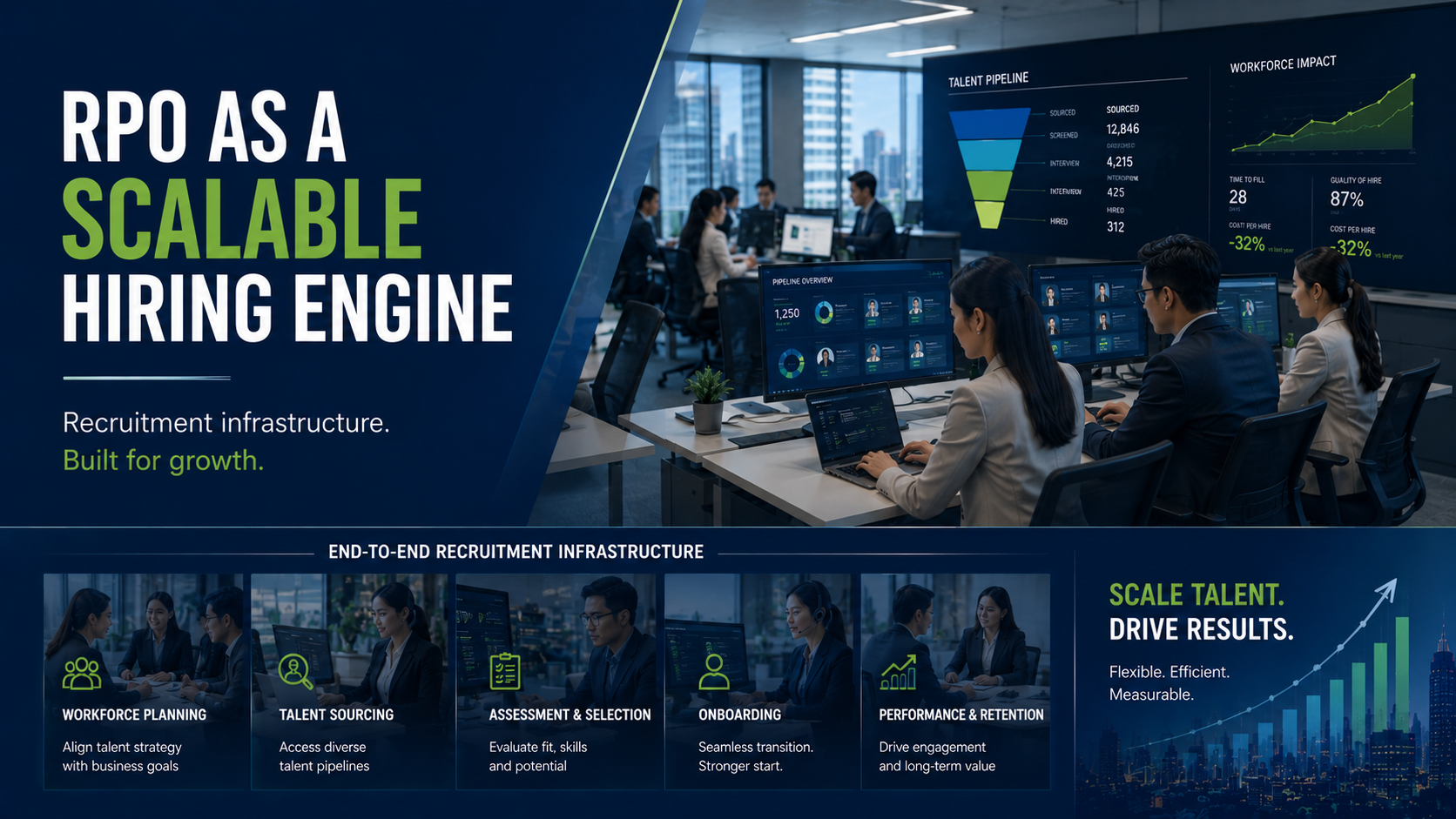
Recruitment Process Outsourcing means transferring responsibility for some or all of your recruitment function to an external provider. Unlike a recruitment agency — which fills individual roles on a transactional basis — an RPO provider embeds into your operations, acts as an extension of your internal team, and manages the end-to-end process from requisition to onboarding.
| Traditional recruitment agency | RPO provider | |
| Engagement model | Transactional — per role, per placement | Ongoing — embedded partner |
| Scope | Sourcing and shortlisting | Full recruitment lifecycle |
| Fee structure | Contingency or retained per placement | Monthly retainer, per-hire, or hybrid |
| Brand representation | Represents the agency | Represents your employer brand |
| Reporting | Placement-level | Pipeline, SLAs, time-to-hire, cost-per-hire |
| Scalability | Ad hoc | Scales with your hiring plan |
| Technology | Agency’s own ATS | Can integrate with your systems |
| Best for | Occasional or specialist hiring | Volume, recurring, or growing hiring needs |
How RPO works in practice
An RPO engagement is structured around your organisation’s hiring needs. A typical setup in the Philippines involves:
1. Discovery and design
The RPO provider spends time understanding your business — your industry, your culture, your hiring volumes by role type, your internal processes, and your employer brand. This is not a box-ticking exercise. The quality of this phase determines everything that follows.
2. Embedded recruitment delivery
The RPO team takes ownership of the recruitment workflow: job brief intake, sourcing, screening, interview scheduling, candidate management, offer coordination, and onboarding support. Depending on scope, they may operate from your offices, remotely, or in a hybrid model.
3. Employer brand representation
When the RPO provider contacts candidates, they represent your brand — not their own. Job advertisements are published under your name. Candidate communications carry your voice. This matters for candidate experience and for how your employer brand is perceived in the market.
4. Reporting and continuous improvement
A credible RPO provider delivers regular reporting against agreed SLAs: time-to-fill, time-to-hire, offer acceptance rate, quality-of-hire metrics, and cost-per-hire. This data allows hiring managers to make informed decisions and gives leadership visibility into recruitment as a business function, not a backroom process.
Types of RPO engagement
| Model | What it covers | Best for |
| End-to-end RPO | Full recruitment function outsourced | Companies wanting to fully divest internal HR recruitment bandwidth |
| Project RPO | Defined scope — e.g. 50 hires in 6 months | Expansion projects, new site openings, seasonal hiring spikes |
| Selective RPO | Specific stages only — e.g. sourcing and screening | Companies with internal capacity at later stages but gaps at the top of the funnel |
| On-demand RPO | Flexible capacity as needed | Growing companies with variable hiring velocity |
When RPO makes sense in the Philippines
RPO is not the right model for every company. It delivers the most value when one or more of the following apply:
- You are hiring 20 or more people per year across similar or recurring roles
- Your HR team is spending disproportionate time on recruitment administration rather than people strategy
- Your time-to-hire is too long and affecting business operations
- You are entering the Philippine market and need a recruitment infrastructure without building it from scratch
- You are scaling rapidly — opening a new site in Cebu, building a tech team in Manila, or expanding a BPO operation — and need to hire at pace without sacrificing quality
- You want consistent employer brand representation across every candidate interaction
RPO is generally not cost-efficient for companies making fewer than 10–15 hires per year on an ad hoc basis. For those companies, a traditional recruitment agency or executive search arrangement is the more appropriate model.
RPO in the Philippine context: what makes it different
Running RPO in the Philippines has its own considerations that a provider with genuine local expertise will understand.
Regularization and probationary period compliance
RPO providers who manage onboarding as part of their scope must be fluent in Philippine Labor Code requirements — including probationary period documentation, DOLE compliance, and the conditions under which employees are deemed regular. Gaps here create legal exposure for the client.
Multi-site hiring: Manila and Cebu
Many Philippine employers operate across both Metro Manila and Cebu. The talent markets are distinct — different candidate pools, different salary expectations, different commute norms, and different employer brand perceptions. An effective RPO provider maintains active sourcing capability in both markets. A7 Recruitment operates from offices in Makati and Cebu, giving clients full market coverage without the overhead of managing two separate recruitment relationships.
Industry-specific sourcing depth
Philippine RPO is most effective when the provider has genuine depth in the sectors they recruit for. Sourcing IT developers requires a different network and different assessment criteria than sourcing BPO operations managers, FinTech product leads, or FMCG sales teams. A generalist approach produces generalist results.
RPO vs. building an internal talent acquisition team
| Factor | In-house TA team | RPO with A7 Recruitment |
| Setup time | 3–6 months to hire and onboard | Weeks to deploy |
| Fixed cost | Salaries, benefits, tools, management overhead | Predictable per-hire or monthly fee |
| Scalability | Slow — headcount-constrained | Immediate — scales to your plan |
| Market intelligence | Limited to internal data | Live market data from active placements |
| IBPAP network access | Not available | A7 is an IBPAP member — access to IT-BPO talent ecosystem |
| Risk | Retention risk on TA staff | Provider accountability via SLAs |
What to look for in a Philippine RPO provider
- Philippine Labor Code fluency — not just sourcing capability
- Sector depth in the industries you hire for
- Active presence in both Metro Manila and Cebu if you operate in both markets
- Transparent reporting and agreed SLAs from day one
- Employer brand alignment — they should represent you, not themselves
- A structured discovery and onboarding process before any hiring begins
A7 Recruitment’s RPO service
A7 Recruitment Corporation is a Filipino-owned talent solutions provider with offices in Makati and Cebu. A7’s RPO service is built on end-to-end recruitment delivery — from job requisition through to onboarding — with tailored strategies for high-volume hiring, specialist roles, and multi-site expansion.
A7’s heritage in structured, process-driven recruitment traces back to its origins within Kforce’s Philippine operations, giving the firm an enterprise-grade approach that most local providers do not offer. A7 is also a member of IBPAP (IT and Business Process Association of the Philippines), providing direct access to the IT-BPO talent ecosystem — a significant advantage for companies hiring in that sector.
A7’s RPO offering covers IT and software solutions, BFSI, FinTech, BPO, Real Estate, Energy, FMCG, Digital Marketing, Logistics, Manufacturing, and Healthcare. The team applies the same philosophy across all sectors: understand the client’s organisational DNA, then build a recruitment process that delivers talent aligned to long-term business goals — not just candidates who fill a vacancy today.
A 2026 development worth knowing: RPO and Employer of Record
A trend gaining traction in 2026 among global companies hiring in the Philippines is the pairing of RPO with an Employer of Record (EOR) service. The distinction is important: RPO optimises the recruitment process — sourcing, screening, and placing candidates efficiently. An EOR handles the employment infrastructure — payroll, statutory contributions, labour law compliance, and contractual obligations. They solve different problems.
For foreign companies entering the Philippine market without a registered local entity, an EOR is the mechanism that makes employment legally compliant. RPO finds the talent; the EOR employs them on your behalf. Together they provide a complete, compliant hiring solution — and for many international clients, this combination is faster and lower-risk than establishing a local entity before hiring begins.
A7 Recruitment’s RPO service is designed for companies that have — or are building — a Philippine legal entity and want a trusted local partner managing their recruitment function. For clients who are still establishing their legal presence, A7 can advise on the appropriate structure before RPO engagement begins.
Is RPO right for your business?
The honest answer is: it depends on your hiring volume, your growth trajectory, and how much internal bandwidth you are willing to dedicate to recruitment infrastructure. For companies scaling in the Philippines, entering the market for the first time, or managing recurring hiring across multiple roles and sites, RPO is almost always the more efficient and better-quality option than managing the process internally.
Talk to A7 Recruitment about whether RPO fits your hiring model: https://a7recruitment.com/services/recruitment-process-outsourcing/
Contact A7’s team directly: https://a7recruitment.com/contact-us/