
For property developers and brokerages looking to grow, partnering with a specialized real estate recruitment agency is one of the more efficient moves available. It gets you to qualified talent faster, reduces hiring risk, and keeps your offers aligned with what the market is actually paying. This article covers where real estate hiring is hardest right now, which roles and salaries to expect in 2026, and what a good recruitment partner should bring to the table.
Why Real Estate Talent Acquisition Is Challenging Today
Three problems recur across developers and brokerages alike. First, there’s a genuine shortage of mid- to senior-level property managers, asset managers, and leasing heads who combine technical knowledge with strong relationship skills. Second, the strongest candidates are rarely actively job hunting, so reaching them takes employer branding and targeted outreach rather than job board postings. Third, a delayed fill on a key property or operations role has a real cost: lost revenue, weaker customer experience, and operational strain while the seat sits empty.
The Modern Real Estate Market Context
The Metro Manila condominium market remains a buyer’s market, with close to 30,000 unsold ready-for-occupancy units still working through the system. Developers have responded by slowing new condo completions sharply (Colliers projects roughly 3,600 units a year from 2026 to 2028, well below the 13,000-unit annual pace seen during the 2017–2019 boom) and by shifting growth toward regional corridors such as Cebu, Pampanga, Iloilo, Clark, Cavite, and Bulacan rather than concentrating solely on Metro Manila towers.
At the same time, the extension of foreign land lease terms to 99 years under the 2025 law has opened up industrial and logistics real estate to new foreign investment, particularly in Central Luzon and the Cavite-Laguna-Batangas corridor. For developers and brokerages, this means hiring demand is shifting alongside the market: less concentrated in high-rise Metro Manila sales, more spread across regional residential projects, industrial parks, and mixed-use developments.
In-Demand Real Estate Roles for 2026
Property managers and leasing officers remain consistently hard to fill, since the role requires both technical property knowledge and steady client-facing skills. As developers expand into regional corridors, sales and marketing roles tied to new project launches outside Metro Manila are growing fastest. Asset managers and portfolio operations staff are increasingly sought by firms consolidating aging inventory or repositioning stalled projects. And the industrial land lease shift is creating early demand for roles familiar with logistics and industrial leasing, a specialization few generalist brokerages have in-house today.
2026 Real Estate Salary Benchmarks
| Role | Junior (0–2 yrs) | Mid (3–5 yrs) | Senior (6+ yrs) |
| Property Sales Executive | ₱19,000 – ₱32,000 + commission | ₱32,000 – ₱53,000 + commission | ₱53,000 – ₱85,000 + commission |
| Property Manager | ₱26,000 – ₱42,000 | ₱48,000 – ₱69,000 | ₱74,000 – ₱106,000 |
| Leasing Officer | ₱23,000 – ₱37,000 | ₱40,000 – ₱58,000 | ₱63,000 – ₱90,000 |
| Head of Sales / VP Development | N/A | N/A | ₱158,000 – ₱317,000+ |
Regional postings typically run below these Manila figures, though the gap has narrowed as developers compete for the same limited pool of experienced property managers across corridors. Sales roles carry meaningful commission upside beyond the base ranges shown, so total compensation should be evaluated against realistic close rates for the specific project type.
Key Benefits of Partnering with a Real Estate Recruitment Agency
A specialized agency gives you access to a wider, more relevant talent pool than in-house sourcing typically reaches, including passive candidates not visible on job boards across Metro Manila and regional markets alike. Because sourcing and initial screening are handled externally, time-to-fill drops, and agencies are positioned to catch red flags (credential gaps, unrealistic tenure claims) before they reach your final interviews. Good agencies also assess relationship skills and integrity alongside technical competence, which matters more in property and brokerage roles than in most other hiring.
Beyond the placement itself, a real estate-focused recruiter gives you current salary and demand data so offers stay competitive without overpaying, along with working knowledge of zoning, permits, and tenant relations relevant to candidate vetting. Many agencies also offer replacement guarantees, which meaningfully lowers the cost of a bad hire compared to filling the role alone. And because hiring needs shift with project cycles, a recruitment partner can scale support up for a launch and back down between them, without you carrying that overhead in-house year-round.
What to Look for in an Agency
| Check | Why It Matters |
| Deep real estate specialization | Property management, leasing, and brokerage each require different vetting. |
| Track record in similar roles | Signals actual capability, not just general recruiting volume. |
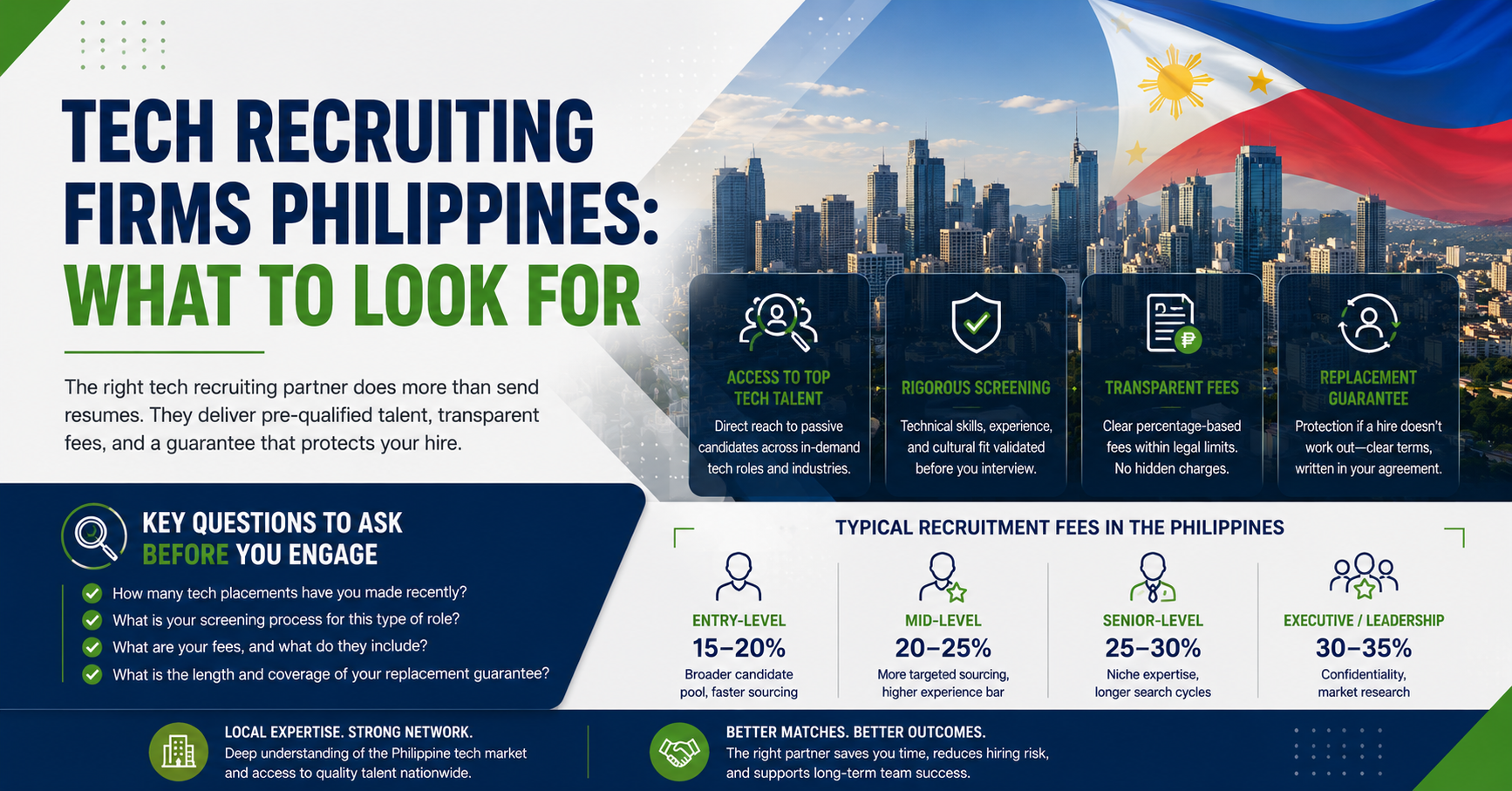
| Transparent fees and replacement guarantees | Keeps cost and risk manageable upfront. |
| Access to passive candidates | Reaches the talent that isn’t actively job hunting. |
| Ongoing market and salary reporting | Keeps your offers competitive as the market shifts. |
How A7 Recruitment Helps
A7 Recruitment Corporation is a Filipino-owned talent solutions provider with offices in Makati and Cebu, serving real estate clients alongside IT, BFSI, BPO, and other sectors. A7 maps the market and approaches passive candidates directly rather than relying on job postings alone, works with you to set realistic job specs before the search begins, and provides localized salary and demand data so your offers stay competitive as hiring shifts toward regional corridors and industrial real estate.
To discuss your hiring requirements with A7 Recruitment, contact our team at https://a7recruitment.com/contact-us/ or explore our services at https://a7recruitment.com/services/.